Step-by-Step Guide to Deploying Salt Open Source

Salt (SaltStack) is a powerful open-source configuration management and automation tool. Below is a step-by-step guide to deploying Salt Open Source for centralized configuration and management. Step 1: Update Your System Before installing Salt, update your package repositories and upgrade your system packages: sudo apt update sudo apt upgrade -y Step 2: Install Salt Master On your master server, install the Salt master package: sudo apt install salt-master -y Step 3: Configure Salt Master ...
April 9, 2025 · 2 min · Cosmin

How to Add Custom Disks with Drive Letters and Labels in Aria Automation (VMware by Broadcom)

If you’re working withAria Automation (formerly vRealize Automation) and want to give users the ability to add extra disks to a Windows VM — and define their drive letter and volume label — you’re in the right place. This guide shows you how to build a flexible and reusable cloud template (blueprint) that handles additional disks dynamically. We’ll cover: YAML blueprint inputs for user-defined disks Cloud-init with PowerShell to configure drives Handling drive letter and label assignment dynamically Ensuring all disks are initialized and formatted properly Step 1: Define Inputs for Additional Disks In your Aria Automation blueprint YAML, start by defining an input array that allows users to specify up to 4 additional disks, including their desired SCSI unit number, disk size, drive letter, and volume label. ...

March 25, 2025 · 3 min · Cosmin
Article cover image

How to Fix Excessive ApiGwServicePrincipal Logging in vCenter

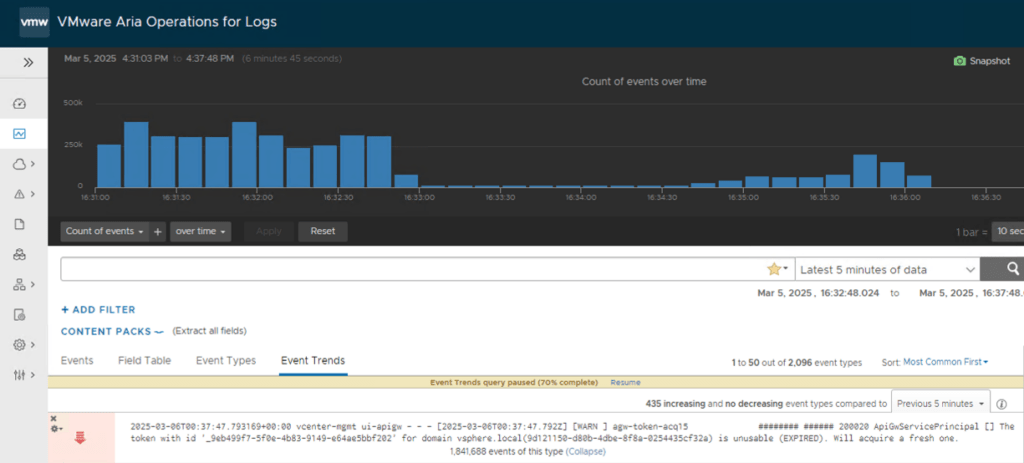
If your vCenter logs are flooded with ApiGwServicePrincipal messages about token expirations, you’re not alone. These frequent “info” level logs in the apigw.log file can clutter your system, making it tough to identify real issues. Fortunately, there’s a simple workaround: adjust the logging severity from “info” to “error.” Below, I’ll guide you through the exact steps to reduce this log noise effectively. The Issue: Too Many ApiGwServicePrincipal Logs In vCenter, you might see repeated log entries like: ...

March 6, 2025 · 3 min · Cosmin

Understanding VMSA-2025-0004 and Protecting Your VMware Environment

Today, I’m diving into a critical issue that demands immediate attention for anyone managing VMware environments: VMSA-2025-0004. Released by Broadcom on March 4, 2025, this security advisory highlights severe vulnerabilities in VMware ESXi, Workstation, and Fusion—products that form the backbone of many virtualized infrastructures. Here’s what you need to know and how to respond, especially since patches are not yet available as of this writing. What is VMSA-2025-0004? VMSA-2025-0004 addresses multiple vulnerabilities that could allow attackers to compromise VMware’s virtualization platforms. The most alarming of these is CVE-2025-22224, a Time-of-Check Time-of-Use (TOCTOU) vulnerability leading to an out-of-bounds write. Rated as critical with a CVSSv3 score of 9.3, this flaw enables a malicious actor with local administrative privileges on a virtual machine (VM) to execute code as the VMX process on the host. In plain terms, an attacker could break out of the VM and take over the hypervisor, potentially gaining control of the host and all VMs running on it. ...

March 4, 2025 · 5 min · Cosmin
Article cover image

Upgrading Aria Operations to 8.18.3 Using a .PAK File

Upgrading Aria Operations (formerly VMware vRealize Operations) is a crucial task to ensure you’re using the latest features, security patches, and performance improvements. In this guide, we’ll walk through the step-by-step process of upgrading Aria Operations using a .pak file. Prerequisites Before starting the upgrade, ensure the following prerequisites are met: Backup the Existing Deployment: • Take a snapshot of all nodes in the Aria Operations (Master, Cloud proxies, and any other nodes). ...

February 28, 2025 · 3 min · Cosmin

Error LCMVRNICONFIG90115 in VMware Aria Suite Lifecycle Manager

If you’re a system administrator or IT professional working with VMware Aria Suite Lifecycle Manager, you might have hit a roadblock when trying to import a VMware Aria Operations for Networks instance. The error in question? LCMVRNICONFIG90115. Here’s what it looks like: Error Code: LCMVRNICONFIG90115 Invalid credentials provided for Console user. Please retry with correct console password. Invalid credentials provided for Console user. Please retry with correct console password. On the surface, this error screams “wrong password!” But even if you’re certain the credentials are spot-on, the issue might persist. Spoiler alert: the fix lies in enabling FIPS mode on the Aria Suite Lifecycle appliance. In this blog post, I’ll break down why this error happens, how FIPS mode resolves it, and provide a step-by-step guide to get you back on track. ...

February 27, 2025 · 4 min · Cosmin

SaltStack Config vs Ansible Tower: A Comprehensive Comparison of Two Leading Configuration Management Tools

In today’s fast-paced IT landscape, managing infrastructure efficiently is a top priority. Configuration management toolslike SaltStack Config and Ansible Tower empower IT teams to automate server provisioning, software deployment, and system maintenance. But how do these two solutions compare, and which one is the best fit for your organization? In this detailed comparison of SaltStack Config vs Ansible Tower, we’ll explore their key features, use cases, strengths, and weaknesses. Whether you’re searching for scalability, ease of use, or seamless integrations, this guide will help you decide which tool aligns with your automation needs. ...

February 27, 2025 · 5 min · Cosmin

Understanding the Differences Between SaltStack and Terraform

In the evolving landscape of infrastructure automation, two tools frequently stand out: SaltStack and Terraform. Both are pivotal for managing infrastructure, yet they cater to distinct needs and operate on fundamentally different principles. This blog post explores what sets SaltStack and Terraform apart, delving into their purposes, architectures, use cases, and how they can work together to streamline your infrastructure workflows. What is SaltStack? SaltStack, commonly known as Salt, is a configuration management tool designed to automate the setup, configuration, and ongoing maintenance of servers. It thrives in environments where consistency and control over server states are paramount. Salt operates on a master-minion architecture, where a central master server orchestrates commands and configurations across multiple minion servers in real time. ...

February 27, 2025 · 4 min · Cosmin

Comparing VMware vSAN ESA and Traditional Storage Solutions

In today’s blog, we’re diving into the world of storage solutions, specifically comparing VMware’s vSAN Express Storage Architecture (ESA) with traditional storage systems like SAN (Storage Area Network) and NAS (Network Attached Storage). If you’re wondering which storage solution is right for your environment, this post is for you. We’ll explore the key differences in architecture, performance, scalability, cost, management, and use cases to help you make an informed decision. ...

February 27, 2025 · 5 min · Cosmin

Tracking Licensed Assets in VMware Aria Automation

I often find myself fielding questions about how to effectively manage and monitor licensing in VMware Aria Automation. Licensing is a critical piece of the puzzle when it comes to ensuring compliance, optimizing resource usage, and maintaining operational efficiency in your automation environment. Recently, I was asked about tracking licensed assets, and I’m excited to share a practical approach using the powerful vracli command-line interface (CLI), specifically the vracli license usage command. In this blog, I’ll walk you through how to leverage this tool to gain visibility into your licensed assets, why it matters, and some actionable insights for managing your Aria Automation deployment. ...

February 27, 2025 · 5 min · Cosmin
VCF Assistant
Hi! I'm the VCF Assistant. Ask me anything about VMware Cloud Foundation, ESXi, vCenter, NSX, Aria Suite, or infrastructure automation.