Upgrading Aria Automation via CLI: A Step-by-Step Guide

Upgrading Aria Automation (formerly known as vRealize Automation, vRA) is crucial for maintaining the efficiency, security, and compatibility of your automation tasks. For environments without VMware Aria Suite Lifecycle, you can still perform the upgrade using the vracli command-line utility. This blog post will guide you through the process of upgrading Aria Automation using two different methods: from a mounted ISO (CD-ROM) and from an online update repository URL. ...

 · Updated  · 
Upgrading Aria Automation via CLI: A Step-by-Step Guide

Enhancing vCenter Server Firewall Management with Ansible

In today’s dynamic IT environments, maintaining a secure and efficient infrastructure is paramount. For VMware vSphere administrators, managing the firewall settings on vCenter servers is a critical task that ensures the security of the entire virtualized infrastructure. Ansible, an open-source automation tool, offers a streamlined approach to managing firewall settings across multiple vCenter servers. This blog post will guide you through automating vCenter server firewall configurations using Ansible, showcasing how to apply these changes across multiple servers seamlessly. ...

Enhancing vCenter Server Firewall Management with Ansible

Streamlining vCenter Server Firewall Management with SaltStack Config

In the realm of VMware vSphere management, securing your vCenter Server is critical to maintaining a robust and secure infrastructure. SaltStack Config, integrated into VMware’s vRealize Automation suite, offers a powerful way to automate and manage configurations across your VMware environment, including firewall settings. This blog explores how to leverage SaltStack Config to automate firewall adjustments on your vCenter servers, ensuring consistent security policies and simplifying the process across multiple instances. ...

Streamlining vCenter Server Firewall Management with SaltStack Config

Mastering the /v1/credentials API in SDDC Manager for Enhanced Security Management

In the rapidly evolving landscape of VMware’s Cloud Foundation, security management is a cornerstone for maintaining the integrity and confidentiality of the software-defined data center (SDDC). The SDDC Manager, a critical component of VMware’s Cloud Foundation, offers a comprehensive suite of APIs for managing various aspects of the SDDC, including credentials management. This blog post delves into the specifics of leveraging the /v1/credentials API in SDDC Manager, offering a detailed guide for VMware professionals to enhance their security posture through efficient credentials management. ...

Mastering the /v1/credentials API in SDDC Manager for Enhanced Security Management

A Step-by-Step Guide to Convert Native Cloud Virtual Machines to On-Prem vSphere with VMware Converter

Migrating virtual machines (VMs) from a cloud environment to an on-premises VMware vSphere infrastructure can be a daunting task. However, with the right tools and processes in place, it can be a seamless and efficient process. One such tool is the VMware Converter, which enables users to convert native cloud VMs\physical servers to vSphere machines. In this blog post, we will discuss the benefits and challenges of converting cloud VMs and provide a step-by-step guide for using VMware Converter to achieve this goal. ...

A Step-by-Step Guide to Convert Native Cloud Virtual Machines to On-Prem vSphere with VMware Converter

Differences between SaltStack and Terraform

Infrastructure management has come a long way in recent years, with a variety of tools and frameworks available to help you provision, configure, and manage your infrastructure. Two popular tools in this space are SaltStack and Terraform, but they serve different purposes and have different strengths. In this post, we’ll explore the differences between SaltStack and Terraform, and when you might choose one over the other. SaltStack: Configuration Management SaltStack is a configuration management tool that allows you to define and apply a set of configurations or settings to a group of servers or other infrastructure components. Configuration management is an important aspect of infrastructure management because it ensures that all servers and systems in your infrastructure are consistent and conform to a known configuration. This can help with security, reliability, and troubleshooting. ...

Differences between SaltStack and Terraform

Why Choose VMware vRealize Automation (vRA) over Terraform

VMware vRealize Automation (vRA) and Terraform target different infrastructure workflows. This comparison covers SDDC automation, user experience, VMware integration, security, compliance, and support. End-to-End Automation: vRA automates the entire software-defined data center (SDDC) lifecycle, from provisioning to decommissioning. Terraform is more limited, focusing only on infrastructure provisioning. User Experience: vRA provides a user-friendly interface, making it easier for non-technical users to request and manage infrastructure. Terraform, on the other hand, requires more technical expertise to use effectively. Integration with VMware: vRA integrates with other VMware products, such as vSphere, NSX, and vSAN, allowing for a seamless experience. Terraform can also integrate with VMware, but it requires more manual effort to set up the integration. Enterprise-Grade Security: vRA includes enterprise-grade security features, such as role-based access control and multi-factor authentication. Terraform does not have built-in security features, requiring additional tools or manual effort to secure the environment. Robust Compliance Features: vRA includes compliance features, such as blueprints that enforce specific policies and standards, making it easier to meet regulatory requirements. Terraform does not have built-in compliance features, leaving it up to the user to ensure compliance. Strong Support: vRA has a large, global community of users and is backed by VMware, a well-established company in the tech industry. Terraform is a relatively new tool with a smaller community, making support and resources more limited. vRA fits an SDDC workflow that needs VMware integrations, a self-service interface, and policy controls in one platform. Terraform fits infrastructure provisioning when the team is comfortable managing state and adding separate controls. I compared both approaches in the three-tier application walkthrough.
Why Choose VMware vRealize Automation (vRA) over Terraform

SaltStack: The Ultimate Tool for Windows Patch Management

Windows systems are vulnerable to security threats and need to be regularly patched to protect against these threats. However, managing patches for a large number of Windows systems can be a tedious and time-consuming task. This is where SaltStack comes in to help. SaltStack is a popular open-source configuration management and orchestration tool that can be used to manage Windows systems, including patch management. In this blog, we will discuss how to use SaltStack to patch Windows systems. ...

SaltStack: The Ultimate Tool for Windows Patch Management
vRealize Operations Manager Administration showing system status with cluster status as online and "Take Offline" button.

Workaround instructions to address CVE-2021-44228 and CVE-2021-45046 in vRealize Operations 7.x

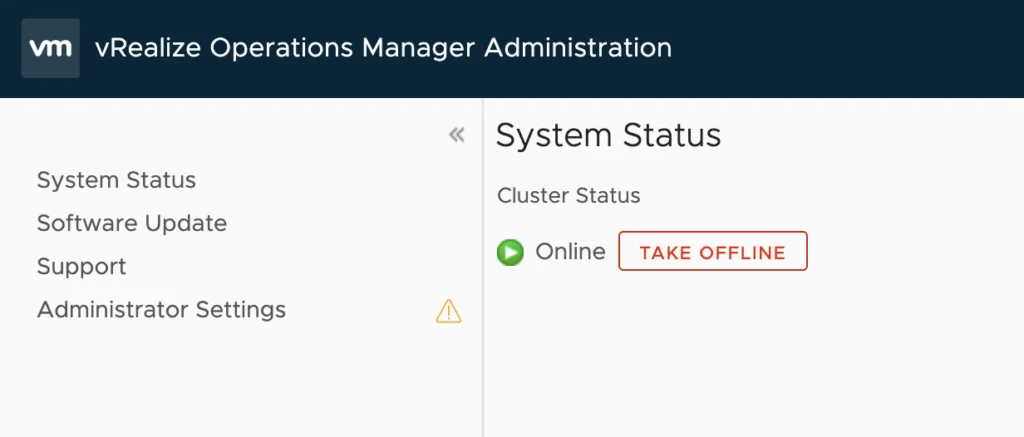
In this article I will go over one of the workaround instructions to address CVE-2021-44228 and CVE-2021-45046 in vRealize Operations 7.x. I have tested the workaround on vROPS 7.5 as its still shipped with VCF 3.x and I haven’t yet seen documentation on a workaround for this version. If you are looking for instructions for version 8.x consult kb article 87076. This has been tested on December 21 2021. Please check the official documentation or open a ticket for production usage. Where possible, moving to a release that ships with the fixed Log4j is the cleaner long-term option. I covered upgrading vROps to 8.6.2 via vRSLCM separately. ...

Workaround instructions to address CVE-2021-44228 and CVE-2021-45046 in vRealize Operations 7.x